How Can We Assess Intent?
Intent is what separates a lie from a mistake. Proving it has defeated every serious domain that has ever tried

When two people share the same story online, its likely that they did it for different reasons. One might have known that the story is false when they posted it and the second might have believed every word.
The reach is often identical. Even the damage can be the same. However, every moral, legal, and social response to each of them lies in completely different territory.
Courts will treat them differently.
Platforms will also treat them differently.
Researchers will certainly study them differently.
More concerningly, governments will respond to them differently.
All of that separation rests on something nobody in the room can see.
This is the load-bearing problem of the entire disinformation debate. Claire Wardle and Hossein Derakhshan clearly identified it in their 2017 report for the Council of Europe.
Disinformation is false information deliberately created to cause harm. Misinformation is false information shared without that intent.
The content can be identical, but what separates them exists entirely within one person’s mind.
The European Union’s Digital Services Act, which came into force for large platforms in August 2023, is perhaps the most ambitious regulatory attempt to address disinformation to date. But, the word disinformation does not appear in the DSA’s actual legal provisions. It appears only in the preamble. The law that is supposed to hold platforms accountable for disinformation cannot formally define it because defining it legally requires establishing intent, and nobody has managed that reliably at scale.
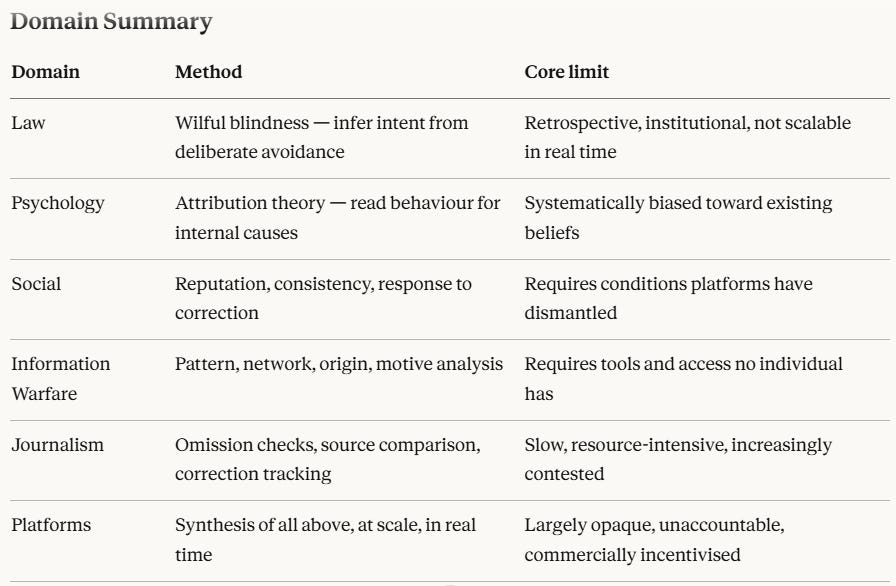
That is not a criticism of the people who wrote the law. It reflects something genuine about the problem. Law, psychology, intelligence analysis, journalism, and platform moderation have all developed serious infrastructure around this idea of assessing intent.
Each has made real progress within its own domain, but each has reached the same wall.
Why? Because intent is an internal mental state, and it leaves no physical trace. It can only be inferred from behaviour, and behaviour is always open to interpretation.
How Each Domain Tries And Where It Breaks
Law — The Honest Workaround
Most legal systems base their approach to intent on mens rea, a Latin phrase meaning “guilty mind.” To commit a crime in most common law traditions, one needs both the act and the intent behind it. The law takes intent seriously enough to make it a fundamental requirement.
However, proving what was in someone’s mind at the moment they acted is nearly impossible without a confession or a paper trail. Courts have addressed this through a doctrine called wilful blindness, which holds that deliberately choosing not to know is legally equivalent to knowing.
The doctrine has since expanded far beyond its origins in forgery and drug trafficking cases. White-collar fraud, corporate liability, and increasingly platform accountability now invoke it. When courts ask what a platform operator knew about harmful content on their service, they are posing the same question law has always asked: did you choose not to look?
The limit is equally concrete, as legal intent assessment works retrospectively. It requires time, evidence trails, witnesses, and institutional infrastructure.
Psychology — The Broken Instrument Everyone Uses
Every person constantly and automatically assesses intent, mostly without realising it. Fritz Heider established the foundations of attribution theory in 1958, identifying that people interpret others’ behaviour by assigning either internal causes (they meant it) or external causes (circumstances drove them). Decades of research since have precisely mapped the biases in that process.
Evelyn Rosset’s 2008 research showed that humans default to assuming intentionality. Concluding that something was accidental requires more cognitive effort, takes longer, and is actively inhibited when a person is already under pressure. Research published in PLOS One in 2015 found that individuals with stronger conspiracist ideation exhibited a measurable bias toward attributing intentionality to ambiguous actions. This means that the people most convinced they can spot deception often work from the most distorted instrument.
A guide that helps people assess intent will, in a polarised population, primarily confirm what people already suspect about sources they distrust, while the same people extend the benefit of the doubt to sources they trust. Psychology describes how we perceive intent but has not produced a reliable method for detecting it accurately, as the two are not the same.
Social and Cultural — The Oldest Method, The Broken Conditions
Long before courts or algorithms existed, communities assessed intent through reputation. People tracked who had been wrong before, whether they corrected themselves when challenged, and whether their behaviour was consistent when they had nothing to gain.
The most transferable signal this domain offers is response to correction. Someone who was wrong, recognises it, and admits so behaves in a structurally different way from someone who was wrong, was told, and doubled down.
Research published in Social Media + Society in 2023, based on over a hundred interviews with UK social media users, found that misinformation spreads most easily through personal messaging channels because norms of social harmony prevent people from challenging what trusted contacts share. The mechanism that should facilitate correction is inhibited by the same closeness that makes sharing persuasive.
The conditions required for social methods have been largely dismantled by platforms. Effective reputation systems depend on smallness, continuity, shared context, and accountability. Online communities are vast, fragmented, contextually impoverished, and often anonymous.
Information Warfare — The Most Powerful Method Anyone Can Access
NATO’s approach to countering information threats, formalised in October 2024, defines information threats as intentional, harmful, manipulative, and coordinated activities, explicitly excluding misinformation on the grounds that it lacks deliberate intent.
This distinction shapes doctrine.
An honest mistake gets corrected.
A coordinated campaign gets countered, attributed, and potentially confronted at the state level.
The methods used to make that determination include pattern of life analysis, network mapping, origin tracing, and structural motive analysis. These are the most sophisticated intent assessment frameworks operating at scale today. A report commissioned by NATO’s Strategic Communications Centre of Excellence and published in early 2026 found that modern influence operations have evolved from high-volume spam networks to AI-generated, human-like accounts that insert themselves into genuine communities to steer perceptions within trusted conversations. The detection problem has become harder because these operations have learned what detection looks for.
However, these methods require tools, data access, institutional backing, and expertise that are unavailable to private citizens. They assess intent at the campaign level but struggle with individual sharers two or three steps from the original source, who may be acting entirely in good faith.
Journalism and Fact-Checking — Transferable But Contested
Investigative journalism has developed methods for discerning intent that are, in principle, accessible to ordinary readers. This includes checking what was omitted rather than only what was said, comparing claims to original sources, and tracking whether outlets correct errors over time.
The omission check is the most underused of these methods. Deliberate disinformation often involves true information stripped of context that would entirely change its meaning. A technically accurate story framed to produce a false impression is harder to correct and easier to defend than an outright lie. Journalism’s focus on what is not present is a genuine and transferable contribution.
The limitation is practical and increasingly structural. Thorough fact-checking takes hours or days. Since 2016, the practice has become actively contested and used as a means of discrediting sources rather than correcting records.
Platforms — The Elephant in the Room
Platform trust and safety teams draw simultaneously on behavioural data, network graphs, account history, device fingerprints, and coordination signals. Their methods borrow from every domain discussed above. They serve as the synthesis point of everything this section covers.
The EU’s DSA Transparency Database, launched in September 2023, represents the most ambitious attempt to make this work visible. A study published in the Proceedings of the ACM on Human-Computer Interaction in April 2025, analysing 353 million moderation records across the eight largest platforms in the EU during the database’s first hundred days, found that platforms adhered only partially to the database’s structure and that a substantial portion of the submitted data was inconsistent.
In 2023, the major platforms began significantly reducing their trust and safety teams. The most powerful intent-assessment infrastructure in the world is primarily accountable to shareholders. The public, whose information environment it controls, has no meaningful visibility into how decisions about intent are made on their behalf.